
- Speak to an insurance agent about your specific needs.
- Know your insurance policy. Make sure your home, vehicle, business and belongings are protected.
Flooding
Disaster Recovery Assistance for Ontarians (DRAO) Program Activated for April 2026 Flooding - Lake St. John Area
The Disaster Recovery Assistance for Ontarians (DRAO) program has been activated by the Province for certain areas affected by flooding in April 2026. Eligible private property owners may apply for assistance if they reside within the activation area, sustained damage as a result of flooding from lakes, rivers and creeks, and do not have insurance coverage for the damage or have insurance that is insufficient to cover eligible essential recovery costs. Please review the DRAO website to see if your property is in the activation area in Ramara.
The purpose of the DRAO program is to return essential property to a basic level, make homes safe and habitable, and allow people to resume their livelihoods. The program is not intended to replace insurance and does not cover all costs.
Damage to secondary residences such as a cottage or other recreational property is ineligible. Damage from sewer backup is also not generally eligible under the program. Sewer backup is water that comes up through floor drains or other connections to the sewer system. Insurance for sewer backup is widely available for purchase as part of homeowners’ insurance policies. An exception is made for low-income households as defined by the guidelines. For information about low-income household guidelines, view additional help for low-income families.
In addition, damage to basements and crawl spaces is eligible to the extent required to return these areas to a safe, basic state. For example, financial assistance can be provided for clean-up, restoration of insulation/vapour barrier, and replacement of essentials like furnaces and hot water heaters. The costs to restore basement finishes (drywall, flooring, etc.) and furnishings are not eligible.
The deadline to apply for the program is November 16, 2026. Guidelines and application forms are available on the DRAO website.
Those affected by flooding are encouraged to contact their insurance provider to determine whether their damage is covered by insurance, prior to applying for the DRAO program.
Any questions about the DRAO program can be sent to the Ministry of Municipal Affairs and Housing at: DisasterAssistance@Ontario.ca.
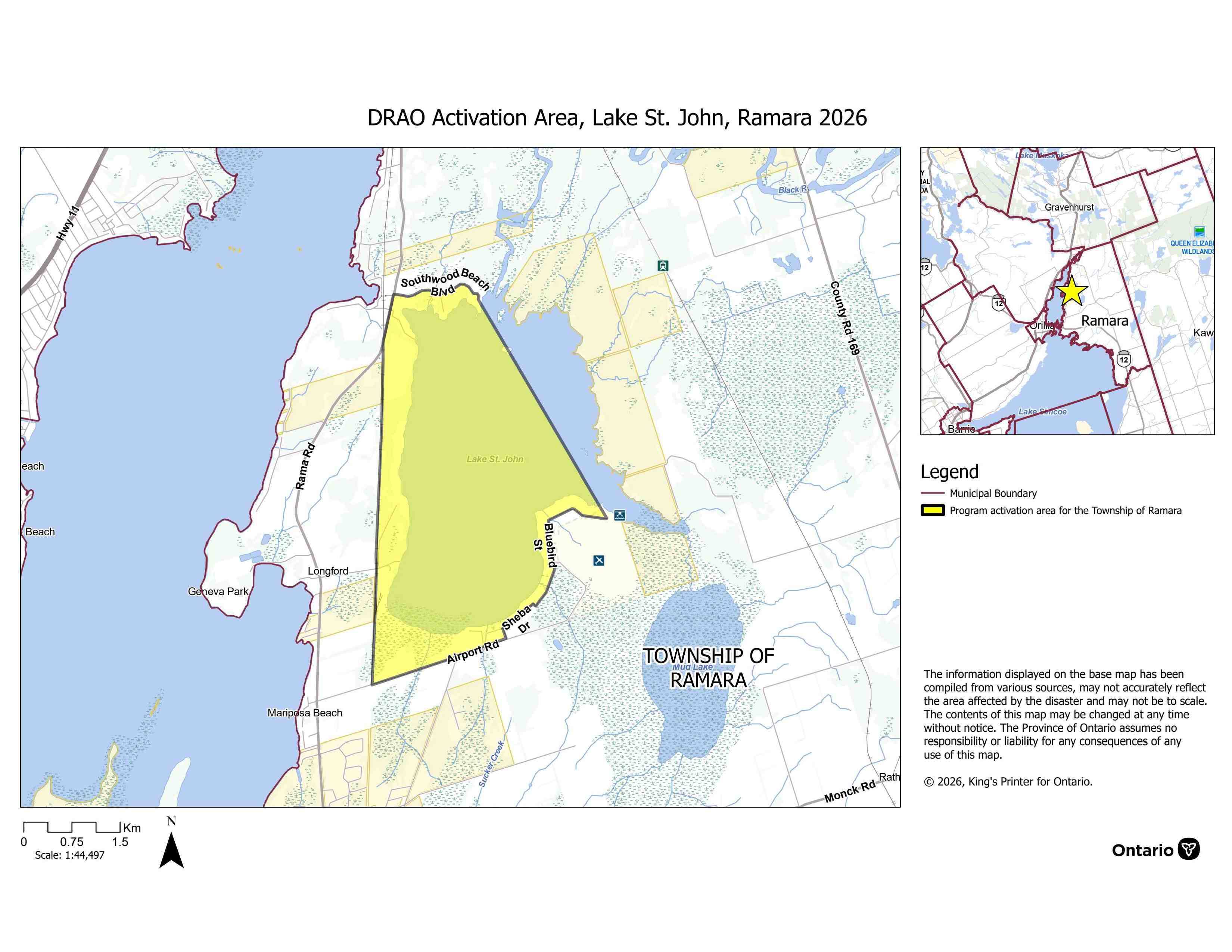
DRAO Activation Area for Ramara, 2026
Every spring, the Township of Ramara proactively monitors water levels throughout the community, including flood warnings and watches from the local conservation authority and the Ministry of Natural Resources.
What to Do During a Flood
In the event of flooding, here are some tips you can follow:
- When approaching a flooded area, don't guess the depth of the water.
- Avoid crossing bridges if the water is high and flowing quickly.
- Don't drive through floodwater and never cross a flooded area on foot.
- Find another route if necessary.
- If your home or business has flooded, watch for electrical shock hazards and gas leaks or odours (sewage).
- Don't enter a flooded area, especially if there is any concern that structural integrity has been compromised.
Protect Your Home from Flooding
- Extend downspouts at least 2 metres from your home to move water away from the building.
- Shovel snow at least 1 to 1.5 metres away from your home’s foundation.
- Put weather protection sealant around basement windows and ground-level doors.
- Keep gutters and nearby storm drains clear of debris and remove debris from water drainage systems such as weeping tile, culverts and ditches.
- Check your sump pump, backup pump and power supply. Ensure they are all in good working order and not connected in the sanitary sewer system.
- Raise large appliances in the basement above potential water level.
- Find your floor drain and make sure nothing is covering it (e.g. boxes, furniture, carpet).
- Learn how to turn off utilities such as electricity and gas in your residence.
- Determine if there are any special precautions required to safeguard electrical, natural gas, fuel oil or propane heating.
Other Tips to Be Prepared for Flooding
- Collect any important documents such as passports, birth certificates, banking information, and insurance papers and store them safely above ground level.
- Protect your valuables in waterproof containers. Place them above potential water levels.
Set up a plan for your livestock ahead of time.
- Ensure that your animals have access to high areas in case of flooding, as well as food and clean water.
- If your property does not have high areas, contact neighbours or surrounding farms to discuss having your animals stay there.
- Make an emergency plan for your animals:
- Create a contact list of emergency phone numbers, including your employees, neighbours, veterinarian, and transportation resources.
- Create a current list of all animals.
- Handling equipment.
- Food, water and emergency supplies.
- Have an evacuation plan for your pet — know a safe place where you can take your pets if a flood occurs.
- Develop a buddy system — plan with neighbours, friends or relatives to make sure someone is available to care for your evacuate your pets it you are unable to do so.
- Build an emergency kit for your pet that includes:
- Food
- Water
- Medicine
- First-aid kit
- Collar with ID tag and harness or leash
- Travelling bag, crate or sturdy carrier.
- Grooming items
- Sanitation needs
- A picture of you and your pet
- Familiar items — toys, treats, etc.
Sign up for our eNewsletter
Stay up to date on the Township's activities, events, programs and operations by subscribing to have notifications sent directly to your inbox.


